
🇰🇷 한국어판: 아데노신 0.04%, 고시가 정한 숫자 (성분 백과 ⑫)
Hello, I’m Dr. J. Today: adenosine in skincare, and what the 0.04% on the back of a Korean wrinkle cream actually certifies.
Pick up three Korean wrinkle creams and you will often find the same ingredient at the same level: adenosine, 0.04%. Different brands, different prices, one identical figure. That is odd enough to be worth explaining, and the explanation is the whole of this guide. It is Ingredient Guide 12.
The short answer: no brand chose that number. It is written into a government document — Annex 4 of Korea’s functional-cosmetics review regulation, which lists four ingredients that may carry a wrinkle claim and the level each one has to be used at. This guide reads those four lines, works out what 0.04% weighs in a jar, goes through the one human trial the number rests on, and then sets the Korean system beside the American and European ones, because neither of those has a list like it.
――――――――――――――――――――――――――――
📄 If you’d rather read the primary sources
📄 MFDS notification, Annex 4 — functional cosmetics for which data submission is waived (Korean)
📄 Abella ML (2006) — 126 women, around the eyes, 8 weeks
📄 Commission Regulation (EU) No 655/2013 — common criteria for cosmetic claims
📄 US FDA — “Is It a Cosmetic, a Drug, or Both?”
🏠 Regulation on the Review of Functional Cosmetics (Korea Law Information Center)
Annex 4 opens as an attachment. The wrinkle ingredients sit alongside the brightening ones in the same table.
――――――――――――――――――――――――――――
――――――――――――――――――――――――――――
In four lines, if you’re in a hurry
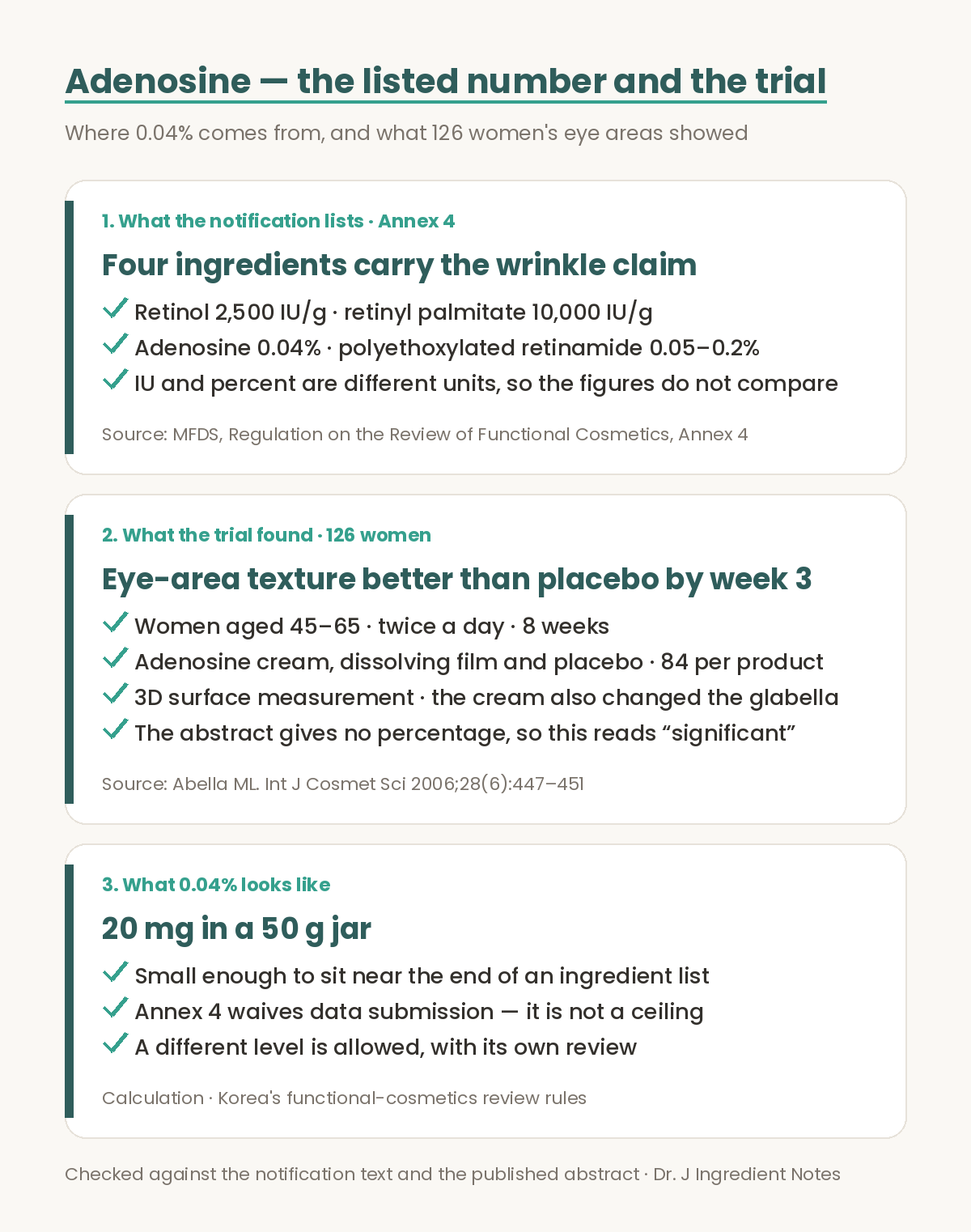
● Adenosine is one of four ingredients Korea lists for the wrinkle-improvement claim
● The listed level is 0.04%. Use exactly that and the efficacy dossier is waived
● Retinol is listed at 2,500 IU/g, adenosine at 0.04% — different units, so the figures do not compare
● 126 women applied it around the eyes for 8 weeks; texture beat placebo from week 3
――――――――――――――――――――――――――――
What it is — a signalling molecule the body already makes
Adenosine is not a laboratory invention. It is what a cell leaves behind after spending energy, so it is already circulating in the body. Skin cells carry adenosine receptors on their surface, and when the molecule docks there a signal travels inward.
What happens after that signal is where published accounts diverge, and it is not something I could confirm from the abstracts available to me, so this guide stops there. What is solid is narrower and more useful: Korea placed this molecule on its wrinkle list rather than its brightening or UV lists, and there is a human trial behind it.
――――――――――――――――――――――――――――
Reading the list — four lines, two units
Here is the wrinkle section of Annex 4 in full. The thing that trips people up is the unit column: the first two entries are given in IU, the last two as a percentage by weight.
| Listed ingredient | Listed level | Unit | Covered in this series |
|---|---|---|---|
| Retinol | 2,500 IU/g | activity units | Guide 1 |
| Retinyl palmitate | 10,000 IU/g | activity units | — |
| Adenosine | 0.04% | percent by weight | this guide, 12 |
| Polyethoxylated retinamide | 0.05–0.2% | percent by weight | — |
An IU measures activity, not mass. Putting 2,500 next to 0.04 and concluding that one ingredient is stronger is therefore a category error — each level was set for that ingredient on its own terms.
Turn 0.04% into something you can picture and it comes to 20 mg in a 50 g jar. That is a normal amount to find near the end of an ingredient list, and finding it there does not mean the product skimped.
――――――――――――――――――――――――――――
Why every jar says the same thing — what Annex 4 actually is
Now read the title of the document. Annex 4 is called “Types of functional cosmetics for which data submission is waived.” It is not a table of guaranteed effects. It is a list of formulations that have already been assessed once, so a company matching one does not have to file its own efficacy dossier.
| Route a formulator can take | What has to be filed | What the label may say |
|---|---|---|
| Match Annex 4 — adenosine at 0.04% | efficacy data waived · reporting route | wrinkle-improvement functional cosmetic |
| A different level, or a different ingredient | efficacy and safety data, individual review | wrinkle-improvement functional cosmetic |
| No listed ingredient, no review | — | no wrinkle-improvement wording |
So 0.04% is not a ceiling. A company that wants more can have more, provided it brings the evidence and goes through the review. The reason the same figure keeps appearing on the back of the jar is that the first route is lighter, not that the door above it is locked.
This also settles a question left hanging in the peptide guide. Peptides are nowhere on Annex 4, so a Korean peptide cream carrying the wrinkle wording either contains one of these four listed ingredients as well, or it went through an individual review of its own.
――――――――――――――――――――――――――――
What the trial found — 126 women, around the eyes, 8 weeks
One human trial sits under all of this. 126 women aged 45 to 65 applied an adenosine product around the eyes twice a day for 8 weeks, comparing an adenosine cream, an adenosine dissolving film and a placebo, with 84 subjects per product.
| Element | Detail |
|---|---|
| Participants | 126 women aged 45–65 |
| Arms | adenosine cream · adenosine dissolving film · placebo, 84 per product |
| Site and frequency | around the eyes, twice daily, 8 weeks |
| Measurement | three-dimensional measurement of the skin surface |
| Result | eye-area texture significantly better than placebo by week 3 · sustained to week 8 · the cream also changed the glabella |
The abstract reports no percentage change, so this guide says “significant” and leaves it there rather than inventing a figure. The number that is worth carrying away is the week 3 mark: the difference appeared inside the first month, which makes 8 weeks a fair window to judge an eye product over.
――――――――――――――――――――――――――――
Why you won’t see 0.04% outside Korea
If you buy the same category of product in the United States or the European Union, the figure disappears. That is not because the ingredient is treated as weaker there. It is because neither system has a list of pre-cleared wrinkle actives at all, so there is no official level for a label to match.
| Question | Korea (MFDS) | United States (FDA) | European Union |
|---|---|---|---|
| A list of approved wrinkle actives? | Yes — Annex 4, four ingredients at set levels | No. Cosmetic products and ingredients need no FDA approval before sale, colour additives excepted | No positive list for these actives |
| What permits the claim | match the listed level, or pass an individual review | intended use decides: a claim about appearance stays cosmetic, a claim to affect the structure or function of the body makes it a drug | adequate and verifiable evidence under the common criteria of Reg. (EU) 655/2013 |
| Where the evidence sits | with the regulator, before launch | with the company; FDA acts after the fact | in the Product Information File, open to the authorities |
| Does 0.04% mean anything? | yes — it is the listed level | no regulated meaning | no regulated meaning |
One footnote on the American column, because it explains a lot of careful wording on US packaging: the FD&C Act has no category for a cosmetic with drug-like powers, and the FDA says plainly that it “does not recognize any such category as ‘cosmeceuticals.’” So an American anti-wrinkle cream talks about the appearance of lines. A Korean one is allowed to say “wrinkle improvement” outright — because a regulator checked the file first.
Neither arrangement is strictly better. Korea’s gives you a number you can verify and a claim someone reviewed; the American and European ones leave more room for a formula that does not match any list. What they mean for a shopper is simply different: in Korea, read the claim wording; elsewhere, read the evidence the brand offers.
――――――――――――――――――――――――――――
Using it — an easy ingredient to place
✔ Morning or night, either works. After a serum, before a cream
✔ Some products carry it alongside retinol. Both are on the same wrinkle list, so they are not a clashing pair
✔ There is no ramp-up period to serve. It does not ask for the first-four-weeks routine the retinol guide describes
✔ The trial looked at the eye area over 8 weeks. If that is where you’re using it, give it that long
✔ Daytime use runs alongside sunscreen — the sunscreen guide’s 2 mg/cm² is the amount that makes that number real
――――――――――――――――――――――――――――
Four things to check when you buy
| Where to look | How to read it |
|---|---|
| The functional-cosmetic wording | On a Korean product this is the tell: it means the listed level was matched, or an individual review was passed. Without it, the wrinkle wording is not allowed |
| Where adenosine sits in the list | Near the end is normal. Ingredients at 1% or below may be listed in any order, and 0.04% is far below that |
| No percentage printed | Levels do not have to appear on the label. The claim wording carries that information instead |
| Is it made for the eye area | That is the site the trial studied. A size and texture suited to the eye area makes 8 weeks of use realistic |
――――――――――――――――――――――――――――
In one line
Adenosine’s 0.04% is a level a regulator set, not one a brand picked — and it is a waiver threshold, not a ceiling. A small number here is not a weak one.
Next in the series: AHA vs BHA — what actually differs (Ingredient Guide 13). Glycolic acid and salicylic acid are regulated in two different ways, which is where that guide starts. The “1% or below, any order” rule gets its space in Guide 14.
――――――――――――――――――――――――――――
📌 Earlier guides
📌 Retinol: Start at 0.1% – How to Read the Concentration Numbers (Ingredient Guide 1)
📌 Skincare Ingredient Compatibility Chart – What to Layer and What to Split
📌 PDRN (Salmon DNA) Skincare: What a Korean Bio PhD Wants You to Know
About the author · Dr. J
MS in Veterinary Medicine, PhD in Life Sciences. I worked as a researcher at the Korea Research Institute of Bioscience and Biotechnology (KRIBB) and now run Beaurea, a cosmetics manufacturing company, where I write the formulas myself. This blog reads the research papers and the regulatory documents and turns them into plain-language criteria for choosing ingredients. I don’t recommend specific products here – only criteria that apply to any product.
📄 References
· MFDS, Regulation on the Review of Functional Cosmetics, Annex 4 — types of functional cosmetics for which data submission is waived
· Abella ML. Int J Cosmet Sci 2006;28(6):447–451 — 126 women aged 45–65, eye area, twice daily, 8 weeks
· Commission Regulation (EU) No 655/2013 — common criteria for claims used for cosmetic products
· US FDA, Is It a Cosmetic, a Drug, or Both? (Or Is It Soap?) — FD&C Act secs. 201(i) and 201(g)(1)
――――――――――――――――――――――――――――
This article summarises published research and public regulatory documents. It is information, not a diagnosis or a treatment plan. If something about your skin worries you, please talk to a professional.
— Dr. J Ingredient Notes